Application of Rigid-flex PCB in Industrial Control
With the development of industrial automation and intelligent manufacturing, industrial control systems are evolving towards greater integration, miniaturization, and improved reliability. Traditional rigid PCBs can no longer meet the demands of increasingly complex structures and performance requirements. In contrast, rigid-flex PCBs, with their structural flexibility and high reliability, effectively meet the needs of industrial control application. As a rigid-flex PCB manufacturer, HoYoGo provide high-precision and high-reliability rigid-flex PCBs, enabling industrial equipment to achieve more stable and efficient operation.
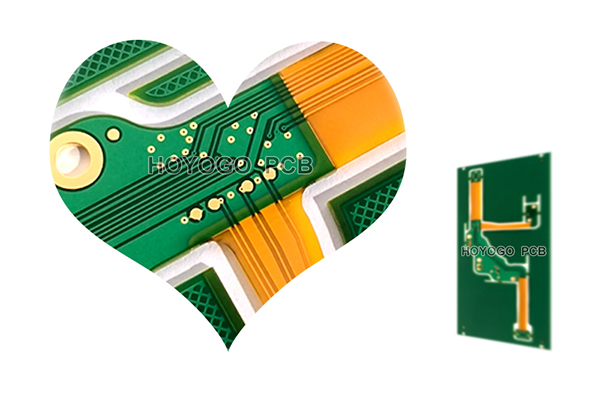
1. Key Features of Rigid-flex PCBs
Rigid-flex PCBs combine rigid and flexible regions, offering both the structural stability of rigid PCBs and the flexibility of flexible PCBs. This structure offers several advantages in industrial applications:
1) Strong spatial adaptability: Supports 3D routing in complex structures;
2) Reduced connector usage: Reduces the risk of poor contact caused by connectors;
3) Improved system reliability: Reduces connection points, thereby lowering the probability of failure;
4) Increased integration: Supports the integration of multi functional modules.
These features make it ideal for industrial control equipment with complex structure and harsh environments.
2. Application Scenarios in Industrial Control Equipment
1) Industrial Control Host and Embedded Systems
Rigid-flex PCBs enable multi-board connections and 3D routing within limited space, helping improve space utilization. At the same time they help reduce risks such as poor contact and improve system stability and reliability. This makes them more suitable for industrial environments that require long-term stable operation.
2) Industrial Robot Control Systems
Industrial robots typically include multiple motion control units, sensors, and actuators, which place high requirements on the structural layout and reliability of their electronic systems.
Rigid-flex PCBs enable flexible routing within complex mechanical structures, supporting electrical connections and signal transmission between different moving parts. At the same time, their flexible interconnection structure helps accommodate stress variations caused by mechanical movement, reduces stress concentration and fatigue damage risks in connection areas, and improve system stability and long-term reliability.
3) Automated Production Line Equipment
Rigid-flex PCBs can improve overall structural integration by enabling connections and integrated layouts across multiple modules, while reducing the use of wiring harnesses and connectors. By reducing potential risks such as poor contact, they can help enhance signal transmission stability, supporting reliable and continuous operation of production lines.
4) Industrial Human-Machine Interface (HMI) Devices
In industrial control panels, touch terminals, and similar devices, connections between displays, control buttons, and main control units are required, with high demands on compact layout and connection reliability.
Rigid-flex PCBs enable flexible connections between display module and the main board, helping optimize overall structural layout and improve space utilization. By reducing the use of traditional cabling, they also help reduce risks such as poor contact and improve system stability and reliability.
3. Role in Signal Transmission
Industrial control systems handle a large number of signal transmissions, including sensor signals, control signals, and communication data. Rigid-flex PCBs help maintain signal continuity by reducing interconnections, which in turn helps reduce risks such as poor contact and external interference. Their structural features help improve signal integrity, enabling the system to maintain stable operation in complex industrial environments.
4. Role in System Reliability
Industrial control equipment typically operates in complex environments involving high temperature, high humidity, vibration, and electromagnetic interference, requiring high reliability from electronic systems.
Rigid-flex PCBs, with their integrated structure, reduce connection points, helping reduce the risk of failure caused by poor contact in vibration-prone environments. Their continuous interconnection structure also helps improve system stability, enabling equipment to maintain consistent performance over long-term operation and further improving overall reliability.
5. Role in Equipment Miniaturization and Integration
As industrial equipment becomes increasingly miniaturized, electronic systems require higher levels of integration within limited spaces. Rigid-flex PCBs, with their 3D routing capabilities, facilitate compact layouts and efficient connections of multifunctional modules, thereby improving space utilization. This makes rigid-flex PCBs particularly valuable for applications such as portable industrial equipment and embedded control devices.
6. Application Value in Industrial Automation
With the advancement of Industry 4.0 and intelligent manufacturing, industrial control systems are continuously evolving, requiring higher levels of integration and reliability in electronic systems. Rigid-flex PCBs, by enhancing integration and interconnection reliability, provide a stable hardware foundation for industrial equipment. They help meet the demands of complex control systems and support higher performance and greater integration in modern industrial applications.
HoYoGo is an international, professional, and reliable rigid-flex PCB manufacturer, specializing in providing highly reliable circuit boards for industrial control, automotive electronics, medical devices, communication equipment, and consumer electronics. In industrial control, our extensive manufacturing experience and rigorous quality management enable us to meet the demands of complex structures, high stability, and long-term operation. Through continuous technological innovation and stringent manufacturing standards, we are committed to providing our customers with stable, reliable, and high-performance PCB products.


评论
发表评论